Tangletown
| Region | Rain Wild |
|---|
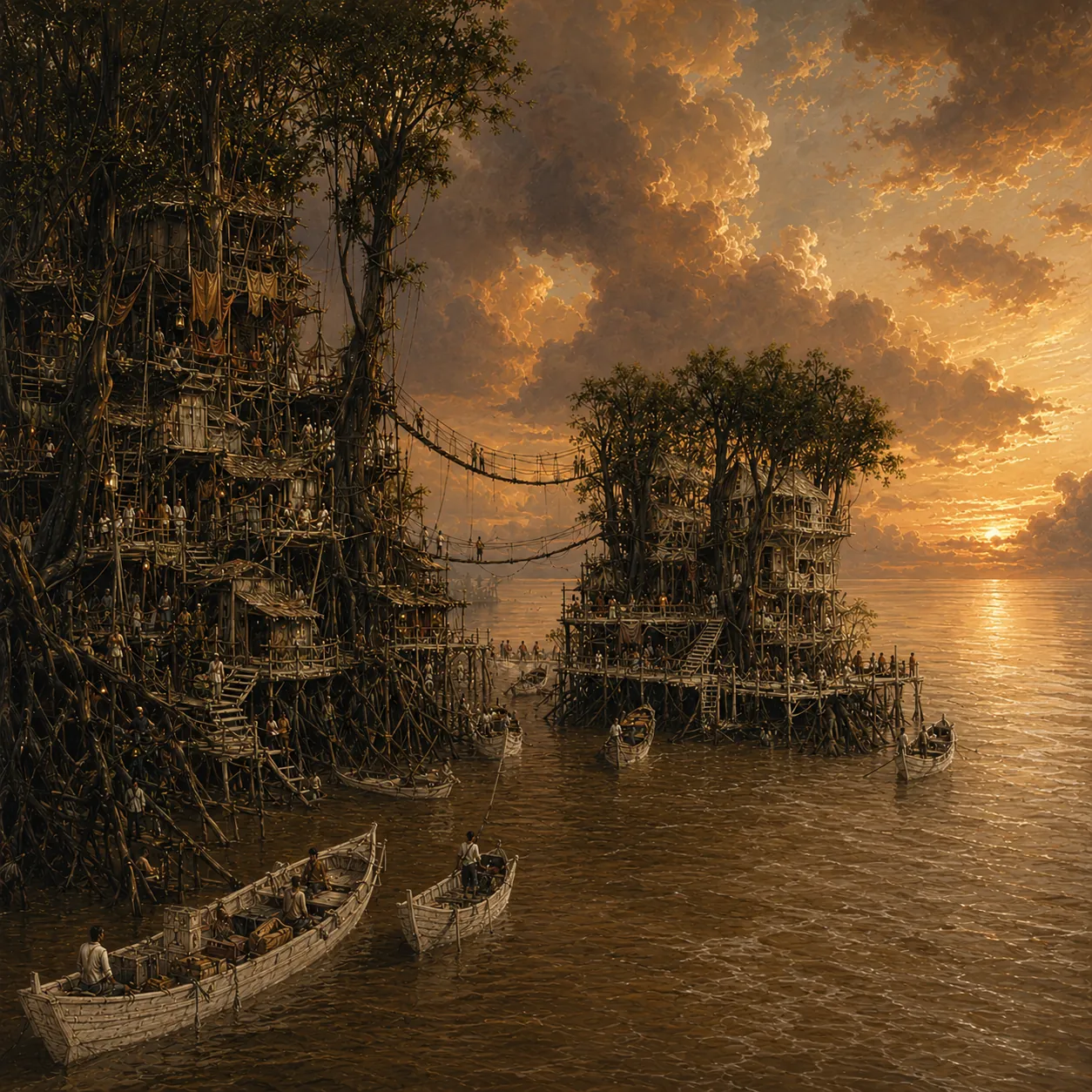
Tangletown is the staging port at the mouth of the Rain Wild River — the last resupply before the upper river closes all other options, and the first thing every expedition sees when it comes back down. It is built entirely on mangrove roots above the reach of the white water: timber walkways, rope bridges, and stilt platforms running between the trees in layers dense enough in the older sections to block the sky. There is no solid ground, no stone, and nothing resembling a plan. It was built fast by people who needed somewhere to stay, and it shows.
| Feature | Detail |
|---|---|
| Location | Bleachwater Bay, mouth of the Rain Wild River, built on mangrove trees above waterline |
| Character | Frontier boom town — improvised, overcrowded, precarious |
| Culture | Every island in the Even Isles represented; no social hierarchy survives long |
| Technology | Rope bridges, timber platforms, stilt construction; early 1800s otherwise |
| Architecture | All timber, built on mangrove platforms — nothing at waterline survives the white water |
| Ruling power | Three layers: Rain Wild Charter (river), Mayor leDuc (town), Dan's Crocs (docks) |
| Current mayor | Gerard leDuc (1016 — election disputed; real enforcement via Dan's Crocs as town watch) |
| Strategic importance | Mandatory waypoint for all Rain Wild expeditions; controls access to the lower cataract |
Bleachwater Bay
The coastal bay at the river mouth. Named for the white chemical outflow that stains the bay during the snowmelt and wet seasons; navigable year-round for sea traffic but visually and chemically distinct from the open coast.
The White Water
Every wet season the Rain Wild River runs white — a chemical surge that dissolves anything in the water within days or weeks. Wood rots, rope frays, metal corrodes; an untended boat left at waterline for a few days may not be there when the owner returns. This is why the gold deposits upstream exist: gold is one of the few materials the white water cannot dissolve, so the river strips everything else away over centuries and concentrates it in sandbars and silted pools.
This determines everything about how Tangletown is built. Every structure stands on mangrove roots well above the normal waterline, sealed and inspected annually. Early construction was haphazard — buildings whose pilings were too short have simply been lost. Experience has taught the builders what holds. The method Garth Banbury and Thomas Triforte developed in 1016, which distributes weight between living mangrove roots rather than fixed pilings, is now standard for anything meant to last.
History
Before 1014 — A backwater: a handful of buildings in the mangroves at the river mouth, connected by rope bridges. The landmarks were The Slippery Root (tavern and brothel), Mama's rooming house, and Kettrick's general store. Few people made it this far who were not already headed upriver.
1015 — Gold rumors brought people flooding in from across the Even Isles. The town roughly doubled in size — houses, supply stores, outfitters, and boat-hire businesses crowding into every gap between the trees. A wide sub-channel of the Rain Wild River to the south prevented expansion toward the Tangleward swamp, and the town grew denser rather than larger. Garth and Thomas organized the first Rain Wild Charter among expedition leaders.
1016 — By the time summer expeditions assembled, the town was dangerously overcrowded. Several outer mangroves had been killed by overbuilding and washed away over winter, destroying the original tavern and brothel and worsening pressure on remaining space. The Charter was re-ratified at Tangletown. Garth and Thomas ran elections hoping to seat Mama as mayor; Gerard leDuc won a count the party still considers crooked. The party then engineered a bridge across the sub-channel, opening the Tangleward swamp for expansion, and drew up plans for a new administrative quarter across the bridge — a city hall, a Expeditionary Society chapter hall, and a Rain Wild Charter hall. Construction is underway as of fall 1016.
Power Structure
Tangletown runs on three overlapping authorities that rarely speak to each other directly.
The Rain Wild Charter (legitimate, river-focused) — governs the river and the lower cataract, not Tangletown's docks and alleys. Governor General Charles Monteforte holds the seat for 1016/1017.
Mayor Gerard leDuc (empire builder) — won his disputed election and has spent the time since consolidating rather than coasting. He genuinely wants Tangletown to grow: more expeditions, more buildings, more institutions, more revenue flowing through the town he controls. He has a claim on the Whispering River managed by an underling, but he is more valuable as mayor than he would be upriver — Tangletown is where the real power is accumulating.
Dan's Crocs (muscle, on leDuc's leash) — leDuc hired Crocodile Dan's gang as town watch after the election: Dan got the dock authority he ran for mayor to obtain, leDuc got enforcers he doesn't fund from his own pocket. In practice the Crocs inspect boats, regulate the wharves, and collect unofficial fees on everything loading and unloading. Returning expeditions carrying gold are the primary target — tired, off their guard, wanting to convert quickly.
The Rain Wild Charter
The Rain Wild Charter is headquartered in Tangletown, where it was formally signed in 1016. A permanent Charter hall and registry office is planned for the New Quarter. Its terms, the Governor General, and its enforcement are covered on the Rain Wild Charter page.
Districts and Landmarks
The Tangle — the original mangrove cluster: oldest, densest, cheapest. Rope bridges, narrow walkways, and stacked platforms between trees that have been built on so many times their shapes are barely visible. Where most of the town's population sleeps and most of its commerce happens.
Mama's — Mama's rooming house and eatery, one of the larger platforms in the Tangle. The best food in town, and the place where expedition leaders negotiate over meals. Mama is the nearest thing the town has to a neutral authority. Since the Slippery Root's destruction in 1016, it is also the only substantial gathering place in the old town.
Kettrick's — the original supply depot, now outcompeted by newer outfitters but still operating. Dilapidated. Stocks things the newer shops do not bother carrying.
The Bridge — Garth and Thomas's 1016 engineering project: a timber bridge across the sub-channel, connecting the Tangle to the Tangleward swamp. The first permanent crossing of the sub-channel. The south bank is still muddy clearing and fresh-cut timber as of fall 1016.
The New Quarter (under construction, fall 1016) — the administrative district planned across the bridge. When complete: city hall, Expeditionary Society chapter hall, Rain Wild Charter hall. Whether Gerard leDuc's administration builds what Garth and Thomas designed, or uses the plans as a starting point for something more convenient to his own interests, remains to be seen. House Vera has already secured a storefront near the planned Rain Wild Charter hall, negotiated by Garth in exchange for backing future mutual-aid arrangements — the New Quarter's first confirmed merchant tenant.