The Even Isles
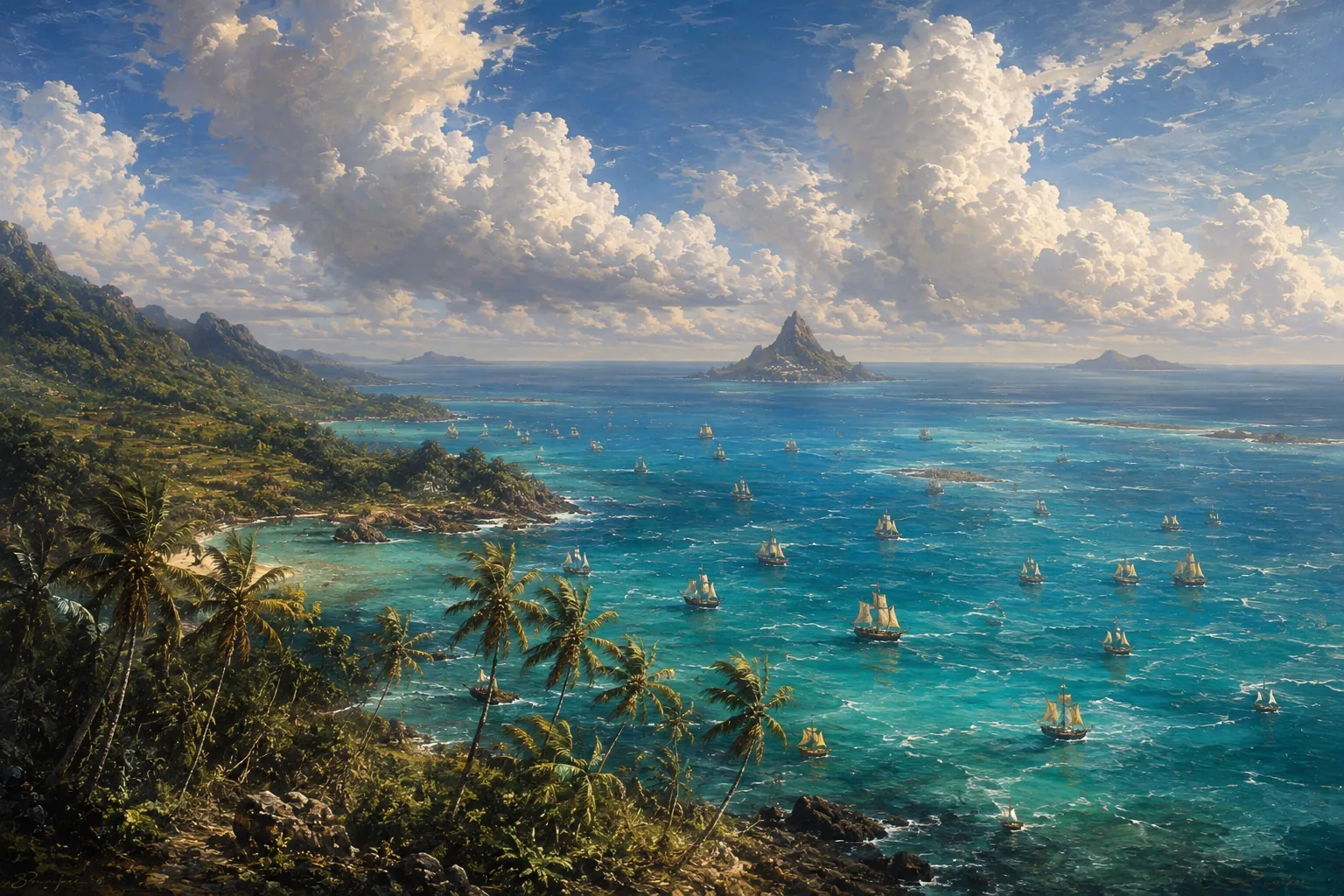
The Even Isles are a tropical archipelago of volcanic and coral islands scattered across a warm inland sea. The islands are fertile, abundantly watered, and sheltered from the worst oceanic weather by the outer island chains. Steep caldera ridges, dramatic headlands, deep harbors, and jungle-choked interiors alternate with white-sand littoral and cultivated plantation lowlands.
The origin of the name is debated. Navigators still use "the Even" as a directional term for west — the islands lie at the far western reach of the known ocean, and "sailing for the Even" means sailing toward the sunset. The founding myth holds that the first mainland sailors raised the islands at dusk, the peaks catching the last gold of the evening sky, and named what they saw. The third explanation requires no history: the light in the Even Isles at late afternoon is simply unlike anywhere else — volcanic haze, warm water, and the angle of the western sun produce long amber evenings that visitors remember. Most residents consider all three explanations equally true and see no need to choose.
Notable Locations
| Capital | Island | Wealth | Allies | Exports | Government | Notes |
|---|---|---|---|---|---|---|
| Port Angelou | Tula | Rich | Vall De Roures | Silk, Gems | Merchant Republic | Dominant power; best shipyards; organizes the treasure fleet. |
| Alba | Almeria | Wealthy, rising | Benabarri, San Lorenzo | Silk | Merchant Republic | Industrializing quickly; funds expeditions to the Mambare River. Positioned to rival Tula. |
| Benabarri | Zaragoza | Wealthy, rising | Alba | Sugar | Constitutional Monarchy | Sugar prices are making it rich fast. Ruled by aristocratic landowners; less commercially flexible than the republics. |
| Vall De Roures | Teruel | Wealthy, declining | Port Angelou | Dwarven goods, food | Merchant Republic | Past its peak; few natural resources, low industrialization. Dependent on its Tulan alliance to stay relevant. |
| San Lorenzo | Cambara | Middling | Alba | — | Fractured Aristocracy | Mountainous, little arable land. Fractious nobility have prevented the centralization needed to compete commercially. |
| Loarre | Colare | Middling | Unaligned | — | Anarchy | Centrally located; trades with everyone. No government to speak of — port is open to pirates, smugglers, and anyone else. Survives entirely on its geography. |
| Bona Coa | Coa | Middling | Unaligned | Artillery | Theocracy | Ruled by the Priests of the Red Fort. Only foundry in the archipelago capable of casting iron cannon — a monopoly they guard and exploit with care. |
| Hearth | Karukera | Poor | Unaligned | — | Anarchy | Tiny southern island; commonly used as a staging point for mainland expeditions. |
| Victory | Ancient Isle | Poor | Unaligned | — | Totalitarian Monarchy | Ruled by King Victor IV. A fortified city at the mouth of the Clay River, encircled by impenetrable jungle. The ruins of Even City lie somewhere in the interior. |
Society
Women of good family navigate a marriage market managed by the matriarchs of the great houses. A young woman of quality is expected to be educated, socially accomplished, and strategically available. Travel and outdoor pursuits are acceptable if handled discreetly; frank commercial ambition is tolerated from older widows and suppressed in younger women.
Commercial Organization
Guilds and Societies
Unlike merchant families, guilds and learned societies operate across all islands simultaneously. The Expeditionary Society is the most prominent — its chapter houses appear in every major port, and its members (wealthy men, and occasional women, pursuing discovery and prestige through expeditions anywhere in the known world) form a network that cuts across house loyalties. The Society holds annual dinners, publishes an expedition journal, and maintains well-appointed halls throughout the archipelago.
Expeditionary Society members are distinct from commercial Rain Wild expeditions: they are self-funded or patron-funded, pursuing discovery and prestige rather than mineral rights. In practice the line blurs — successful discoveries tend to produce commercial interest, and commercially motivated expeditions often employ Society members as experts.