Port Angelou
Tula
| Region | Even Isles |
|---|
Tula is the largest island in the Even Isles — long, mountainous, and dominated by its capital. Port Angelou sits on a sheltered deepwater bay on the island's eastern coast. It is the commercial heart of the archipelago and the city that organizes the treasure fleet.
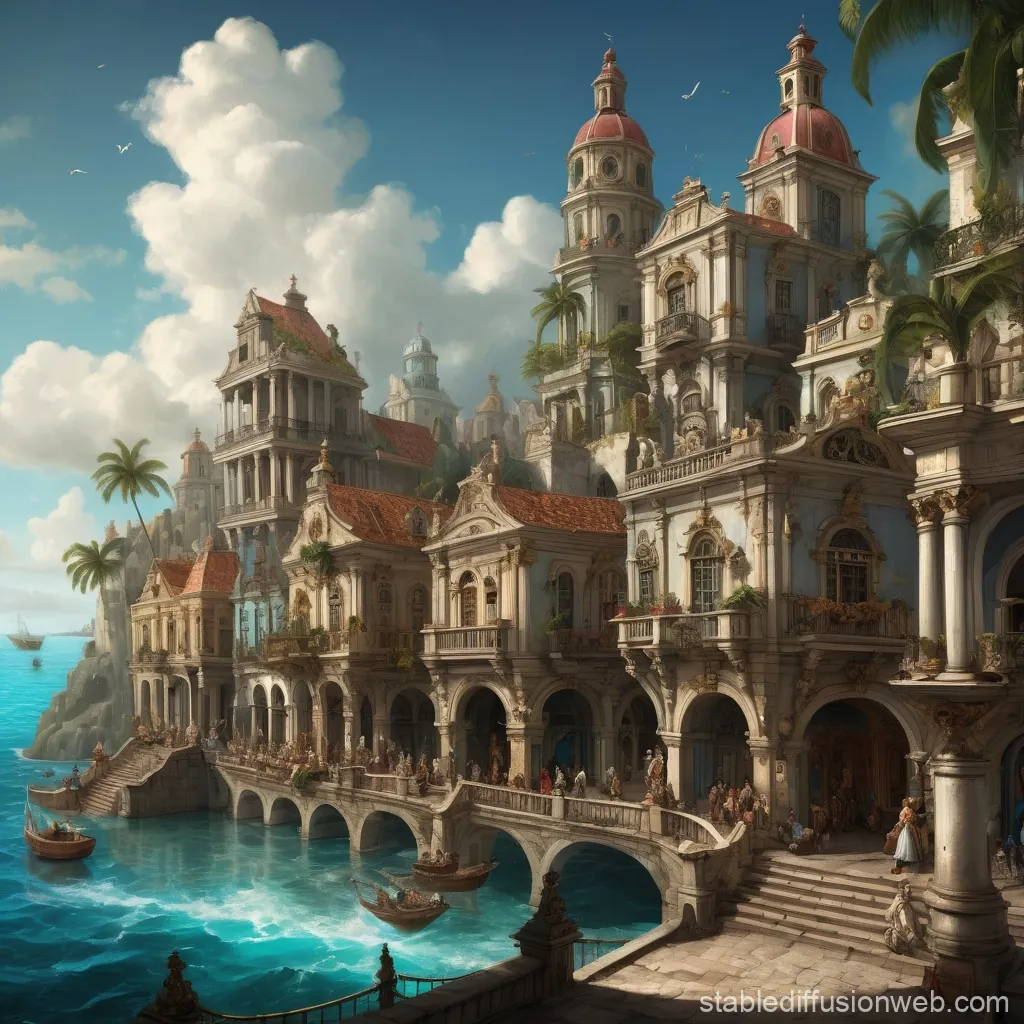
Port Angelou presents three different faces depending on where you are standing. The Hill and the great public buildings are marble — symmetrical facades, shaded colonnaded galleries, wrought-iron rejas over tall windows, and red-tiled roofs; classical proportion married to Mediterranean weight, built to last and to impress. The Trade Quarter below is the local creamy sandstone: deep verandas, open interior courtyards, ironwork balconies, the whole vocabulary slightly looser and more adapted to the heat. The Docks are stucco and timber — dense, functional, perpetually patched, and smelling of tar, salt, and rot. Near the waterfront it is noisy and crowded at all hours. Further up the hill the noise gives way to shaded promenades, carriages, and garden parties.
| Feature | Detail |
|---|---|
| Location | Deepwater bay, eastern coast of Tula |
| Character | Caribbean colonial — Port Royal, Veracruz, Tortuga |
| Culture | Maritime mercantile; classical and Mediterranean influences |
| Technology | Early 1800s Age of Sail |
| Architecture | Three tiers: marble (public buildings, hill mansions) → creamy sandstone with verandas and iron courtyards (merchant quarter) → stucco and timber (docks and lower districts) |
| Ruling power | Merchant houses — no hereditary monarch, no standing military government |
| Social currency | Money, then family connections; military prowess a distant third |
| Strategic advantage | Finest shipyards in the archipelago; builds the ocean-going fleet |
| Primary ally | Vall De Roures |
The Merchant Houses
The rough alignment: the Monteforte bloc controls the transoceanic fleet and the manufacturing economy that supports it. The Vidal bloc holds the older landed wealth — plantations, mines, interior estates — and views the Montefortes as lucky upstarts who happened to be first to the ocean crossing.
The Monteforte Bloc
House Monteforte is the dominant house in Port Angelou today — and would have been unrecognisable as such a hundred and fifty years ago. Before Rodrigo Banbury, the Montefort name barely registered. They were minor factors in the inter-island trade, without land, without fleet equity, without the standing to be taken seriously by the established houses. What Rodrigo had was vision, a head for commerce, and the wit — so the legend goes — to marry into the Banbury fortune. He merged the two family names, hired Adelina Dubois as captain and Ian Flanagan as navigator, and persuaded the Banburys to back a transoceanic crossing that every established house had declined to fund. The returns were staggering. Every subsequent cycle they reinvested aggressively: more ships, bigger yards, manufacturing capacity, administrative control of the fleet schedule. Within a generation, the house that no one had taken seriously ran the archipelago. Monteforte wealth is almost entirely liquid and leveraged — they are always running, always extending credit, always one catastrophic fleet loss away from a crisis they are confident will never come. The matriarch manages their marriage politics with considerable skill. Their Rain Wild concession is profitable but expensive to hold.
The Tula Montefortes are aware that the descendents of Kelvin Montegue's trade empire on the far side of the ocean is far larger and richer than what remains on Tula. However, the catastrophic fleet losses of 993 have reduced reliable contact to when the treasure fleet sails.
House Breckenridge
House Breckenridge handles inter-island distribution for the Monteforte bloc, moving manufactured goods, refined steel, precision instruments, and processed metals out of Port Angelou, traded at significant margins for the other islands' exports — timber, sugar, foodstuffs, raw materials that Tula's own exhausted interior no longer produces. A shipment of Tulan-made goods fetches considerably more in Alba, Benabarri, or Loarre than it cost in Port Angelou, and the Breckenridges have spent a generation learning exactly how much more, and from whom.
The consequence of being in every port is that they know everything. Ship movements, house finances, political marriages in negotiation, which governors are taking bribes and from whom — the Breckenridge agents collect it as a byproduct of doing business, and the family passes what is useful to the Montefortes as a matter of course. They are the alliance's intelligence network by accident of geography, and have long since stopped pretending otherwise. Every other house in the archipelago suspects this. None of them stop trading with Breckenridge factors, because the profits are too good.
House Harrow
House Harrow grew out of the navigation trade: charts, instruments, chronometers, and the specialist knowledge needed to make the transoceanic crossing safely. They were indispensable in the early decades when the route was new, and invested their fees into Monteforte-financed fleet shares. Now a mid-tier house with money in both instruments and fleet equity; technically independent but practically Monteforte-aligned through interlocking investment.
House Dunmore
House Dunmore provisions the fleet. Their warehouses line the western docks; their salt-beef, ship's biscuit, rum, and cordage go into every Tulan vessel. They did not pioneer the transoceanic trade but they quietly became essential to it, and Monteforte alliance followed from necessity. A practical family without aristocratic pretensions, respected at the docks and largely ignored on the Hill.
House Banbury
House Banbury is the landed half of the founding merger — old money that predates the transoceanic trade by generations. Their wealth is in the hinterland: vineyards and orchards on the slopes of Mt Sai, and agricultural estates in the interior valleys that have been producing steadily for generations. When the Monteforte trading company consolidated under the Monteforte name after Rodrigo's crossing, the Banburys accepted a subordinate position in exchange for alliance — their land was secure regardless, and the arrangement gave them access to fleet profits without fleet risk. They are the quietest members of the Monteforte bloc, and the most stable. Unlike every other house in the alliance, a catastrophic fleet cycle would not ruin them.
The Vidal Bloc
House Vidal was the leading family in Port Angelou in the six decades between the Second Cataclysm and the first ocean crossing — the house that filled the vacuum left by Montegue's decline and built the most successful landed estate network on the island. Their wealth is in land: gem mines in the southern mountains, silk estates in the drier interior valleys, and several profitable plantations on the western coast. They did not lose money when Monteforte opened the ocean trade — the demand for their export goods increased enormously — but they lost position, and they remember it. The Vidal patriarch is old, proud, and increasingly reliant on a political strategy (alliance-building, marriage into the Benabarri aristocracy) that moves more slowly than Monteforte's commercial one. Their money is solid, illiquid, and unlevered. In a bad fleet cycle they would survive where Monteforte might not; in a good one, they fall further behind.
House Alcazar
House Alcazar holds the oldest silk estates on the island — old enough that the family claims they planted the first mulberry groves. Whether true or not, they were wealthy before Monteforte existed and are proud of it. Their political loyalty is to Vidal by custom and marriage, though they are not above quiet negotiations with Monteforte factors when prices are right. A conservative family that moves slowly and holds grudges long. The 993 fleet catastrophe that crippled Dorado and Dubois struck Alcazar too — Arturo Alcazar lost his own son with the fleet — and the house has avoided blue-water ventures since. An unresolved lawsuit against House Monteforte, twenty years old, still stands between the two houses. Fredrick Breckenridge believes Arturo Alcazar is the Vidal bloc's de facto spymaster.
House Rivas
House Rivas made its money in inter-island trade and coastal ferry routes — a business the transoceanic boom made look small almost overnight. They resent Monteforte specifically, blame them for the diminishment of inter-island commerce, and back Vidal less from ideology than from shared grievance. A scrappy, well-connected family at every port in the archipelago; useful to Vidal as an intelligence network if not as a financial force.
The Independents
House Whitmore writes maritime insurance. They charge Monteforte ships and Vidal ships and every other ship the same rates, adjusted for risk, with no political discount. Their neutrality is their product — the moment they take a side, half their clients walk. They are courted constantly and commit to nothing. Probably the most genuinely informed house in the city about the actual state of the leviathan risk, since they price it.
House Dorado
House Dorado had significant capital before the ocean crossing from gem speculation and early fleet investment — then lost nearly everything in a single catastrophic return voyage twenty years ago. They have been rebuilding since, slowly, on a combination of salvage contracts, small fleet shares, and careful marriage. They court both blocs for investment and alliance without quite committing to either. The other houses watch them with a mixture of sympathy and wariness: a family that has been ruined once is either cautious or desperate, and it is not always obvious which. There are persistent rumours that some of their recovery capital came from piracy — operating through intermediaries out of Loarre. Almost certainly unfounded. The numbers, however, do invite the question.
House Vera
House Vera is small, specialized, and deliberate. They control the trade in a specific category of Rain Wild exotica — rare pigments, specific botanical extracts, materials that are not gold but command extraordinary prices from old-world buyers who know what they are. They have no interest in fleet politics, fleet financing, or marriage alliances above their station. They are rich enough to be comfortable and careful enough to stay that way.
In 1016, Elena Vera broke from that caution for the first time in a generation — backing Leo and Garth's Rain Wild expedition, committing a storefront in Tangletown, and reaching for a legendary Vall De Roures moss no House Vera money has ever bought.
House Dubois
House Dubois is one of the oldest families in Port Angelou — sugar planters since before the Second Cataclysm, with northern lowland estates that have outlasted every upheaval the archipelago has survived. Their wealth is in land, not fleet shares. The family's most distinguished name is Adelina Dubois, captain of Rodrigo's founding voyage. Her original charts remain in the Tula family archive. The treasure fleets are the only contact with her branch, and the archive has not been opened in years. Twenty years ago a catastrophic return voyage took a significant portion of their fleet investment. The estates absorbed the blow, but the family got out of speculation entirely and has largely withdrawn from public life since. There are rumours of a family curse.
House Montegue
House Montegue is the oldest name in Port Angelou — the dominant power before the Second Cataclysm, hugely wealthy and prestigious before the ocean crossing remade the commercial order. The Cataclysm eroded their position; the transoceanic age finished it. Kelvin Montegue sailed with Rodrigo's founding voyage, and he and Marco built far-shore empires far richer than anything left on Tula, and took the family's best people with them. What stayed is Sebastian Montegue's branch.
What it stayed to do is antiquities. House Montegue is now the leading dealer in pre-Cataclysm artifacts — unearthed on the continent, recovered from the Even Isles, or brought back from old-world expedition sites. No other house has their institutional memory: old records, family archives, the commercial and scholarly language of the pre-Cataclysm world. They can identify what others dismiss as junk, and they know what old-world collectors will pay for the real thing. Revenues have grown steadily as Rain Wild expeditions multiply. The other houses consider this eccentric. Sebastian Montegue watches the trend and says nothing. Their independence is deliberate — it gives them room to deal with anyone who brings them something old.
Media, a minor cousin who partnered with Garth to identify an Imperial medallion in Lord Pemberton's collection, comes from this house.
House Pemberton
A minor family of the Hill, outside the blocs. Lord Pemberton collects antiquities: Garth and Media identified an ancient Imperial medallion in his collection at the Pemberton party (Spring 1016), which Leo and Garth attended. Lyssa Pemberton is a minor cousin of the house.
Districts
The Docks — Stucco and timber: warehouses, chandlers, ship fitters, counting houses, and taverns packed tightly along the waterfront. The working heart of Port Angelou. Crowded at all hours during the build-and-load phase; quieter and tenser during fleet-away years when credit is tight and men are waiting for news.
The Merchant Quarter — Creamy sandstone: colonnaded halls, factor offices, and the open-courtyard counting houses of the mid-tier trading families. Deep verandas, ironwork balconies, and interior patios keep it livable in the heat. Where contracts are negotiated, disputes are settled, and house agents conduct the daily business of trade. The Expeditionary Society hall is here.
The Hill — Marble and dressed stone: the grand mansions of the major merchant families, the civic hall in the old governor's redoubt, and the cathedral. Symmetrical facades, shaded colonnaded galleries, and wrought-iron rejas over tall windows. Where the matriarchs of the great houses hold court, where marriages and significant dinners are conducted, and where the social season plays out.
The Shipyards — South of the harbor mouth, on a broad flat stretch of shoreline. Functional timber and iron construction — no pretension here. The largest dry docks in the Even Isles. Access is controlled; the techniques used are Tula's most closely guarded commercial secret.
Mt Sai
The volcano at the centre of Tula. Its slopes are the city's hinterland — vineyards and orchards — and the Banbury manor and estates stand there.