Church of the Emperor
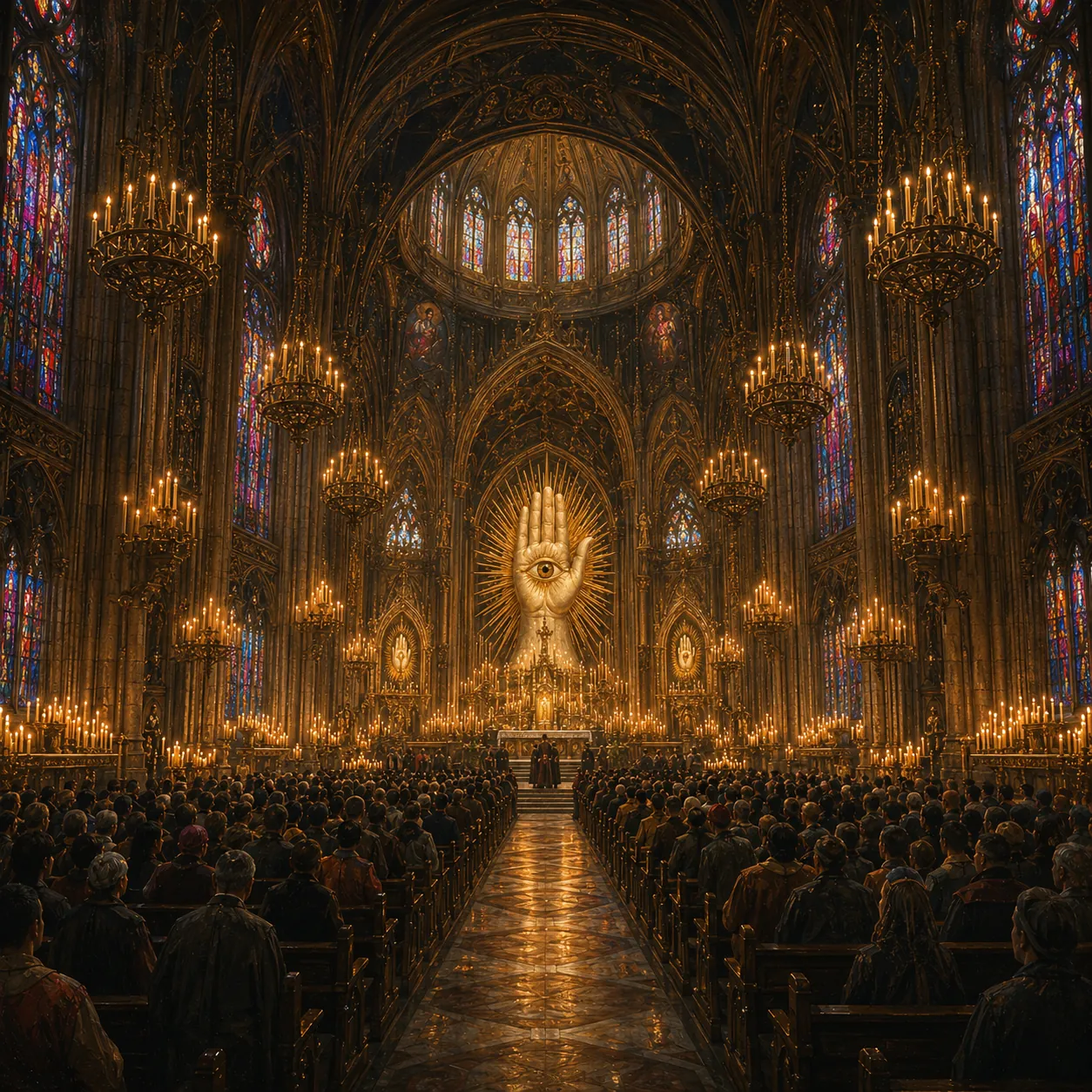
This represents the ordinary educated opinion on the Church's own history — what most people have pieced together from sermons, half-remembered schooling, and old sailors' tales — and it gets vaguer the further back it reaches.
The deep past (before the Second Cataclysm c. 800)
Most people know only the broadest shape: that the Church's faith cracked into countless rival cults in the dark centuries after the Sundering, was pulled back together under the domination of Central City, and then broke apart again along national lines during an age of heresy and war before the Second Cataclysm. Few could name a single doctrine or symbol from any of it — it's schoolroom history, several centuries deep, and only church historians and scholars are interested in the details.
The Oraculum doctrine
The first priests of Oraculum reached Port Angelou soon after the founding crossing, and their miracles were real but narrow: a storm's course named before it broke, a lost ship found, a hull warned off a reef it never saw, a pattern picked out of chaos, a message carried a thousand miles in an instant. Never healing. Never command. The Church built new doctrine directly on that gap:
- Providence over power. The Emperor's grace was retaught as watchfulness, warning, and guidance rather than intervention — he sees, warns, and shelters those who heed him; he does not reach down and do. Protection, in this telling, is never a wall thrown up after the fact — it is danger seen far enough ahead to be walked around.
- The sorcerers, named and answered. Ordinary people who struck their own bargains with the elder spirits could actually heal and command weather — power the Church itself couldn't match. Rather than concede the point, doctrine recast that power as the lesser gift: bought, not given; blind to the whole pattern; a mercy that costs the taker something the Church never asks for. The word settled on for them was sorcerer, preached against hard from every pulpit that still had a congregation — but never called heresy outright.
- Symbology followed doctrine. The raised hand gained a watchful eye set in the palm; temple art absorbed ledgers and star-charts, and the old radiant sun gained an unblinking eye of its own — watching became the image's whole point, doing warding's old work by a different means: not a shield that turns harm aside, but an eye that never lets harm get close enough to need one.
The Silence
On October 13th, 957, Oraculum's priests went mad overnight, and the miracles of knowing stopped as suddenly as they'd started. Church teaching absorbed the blow in three moves: it named the madness a correction, not a tragedy — proof that people had let a watching machine stand in for real faith in the Emperor himself; it quietly retaught the eye on every priest's hand as having always been the Emperor's own uninterrupted vigil, Oraculum's part in it edited out of the sermon entirely; and it stopped promising visible miracles at all, teaching instead that grace is felt through faith and endurance, not evidence. As the sorcerers also seemed to lose access to their powers at the same time, the church capitalized on its own institutional history and credibility, bringing more faithful back into the fold.
The Isles' own church
The islands themselves have no history before the Age of Bone — survivors of the old Empire's Disk Cities spread out into hospitable, unclaimed islands in the hard scramble after the Cataclysm, and the Church came with them from the very start, not planted later by any grand mainland cathedra. It is, in its own quiet way, the oldest continuously-run institution in the archipelago — older than any merchant house, older than the republics themselves. That local birth cost the Isles later: when the Spiritbound Age's Oraculum went looking for surviving cathedrals to reconnect through, it needed a pre-Cataclysm cathedral to anchor to, and the Isles — settled only after the Cataclysm — had never had one. Lemburg, Khrost, Lindis, Leonroth, and a fifth distant see got the better part of a century of access to restored travel and trade; the Isles watched a network they'd never belonged to reopen without them.
Resurgent, but hollow
Since the Silence quieted the elder spirits people had turned to faith instead. Congregations have swelled past anything a living priest remembers — every island capital's chapel fuller now than in generations. What the Church still can't buy back is power to match the attendance: no relic-miracles, no army, no monopoly worth taxing. Just pews, processions, and the standing that comes from being the only door still open.